Krea is a creative AI suite for generating, editing, and enhancing images, videos, and 3D assets. The product has grown from a realtime image tool into a multi-model creative platform with Krea 2, Realtime, Video, Enhancer, Nano Banana, Edit, Lip Sync, Motion Transfer, 3D, LoRA training, Nodes, Apps, API, and team workflows.
Krea Review: Excellent Visual Playground, Not a Film Planner
Krea feels less like a single generator and more like a visual AI workbench. When I open the app directory, the useful thing is not one headline model; it is the way image generation, video generation, enhancement, realtime creation, editing, LoRA training, assets, and node workflows sit next to each other.
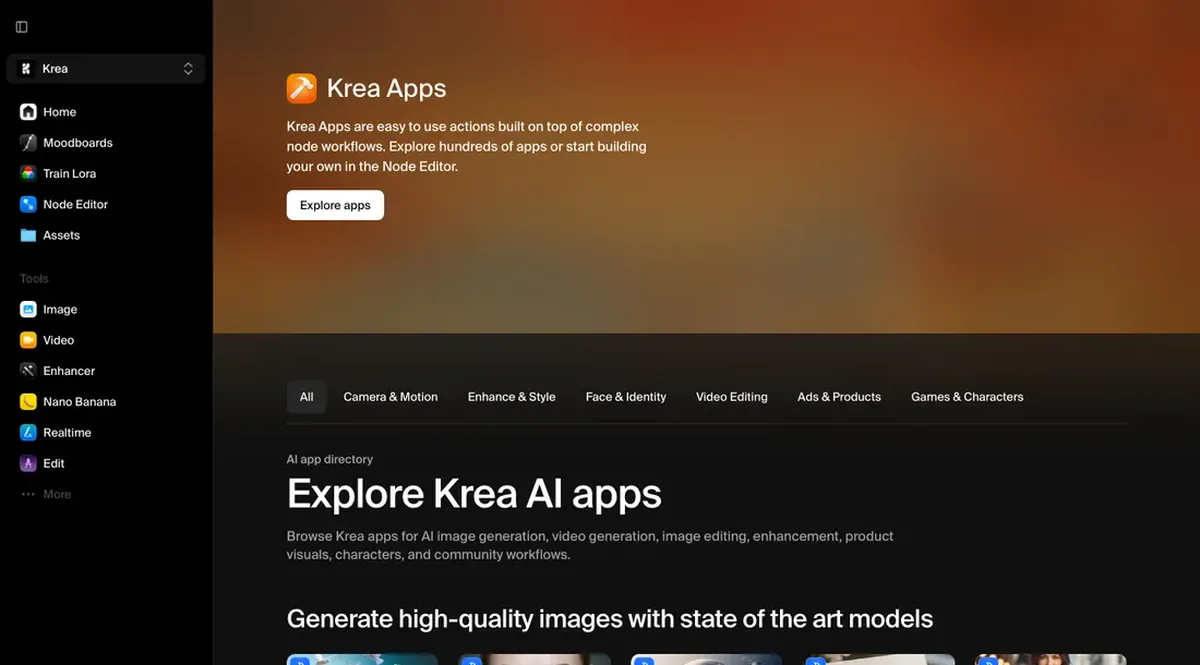
The apps directory is the clearest snapshot of Krea's current direction: it is trying to be the place where visual creators test models, polish assets, and turn repeatable creative processes into apps.
What I like most is that Krea keeps a lot of advanced visual work in one place. It supports a broad model ecosystem, including names like Veo, Runway, Luma, Flux, Gemini, Krea's own models, Topaz, Magnific, Seedance, and Nano Banana. For filmmaking-adjacent work, that makes Krea useful for styleframes, poster concepts, upscaling, video model experiments, motion tests, and visual cleanup.
Krea Features: Images, Video, Realtime Tools, and Apps
Krea is unusually broad for visual production. The core workflows cover text-to-image, realtime generation, text-to-video, motion transfer, image animation, image and video upscaling, frame interpolation, 3D generation, lip sync, generative editing, LoRA fine-tuning, moodboards, style references, node workflows, apps, and API access.
For filmmakers, I would use Krea as a visual lab rather than a film studio. It is strong for look development, styleframes, posters, environment references, AI image editing, upscaling, video generation, video restyling, and model comparisons. It is weaker once you need to organize a script, scenes, characters, voice, music, sound effects, and a coherent production workflow.
Krea Pricing: Flexible Creative Plans With Usage Limits
Krea's plans are compute-unit based, so the practical cost depends heavily on model choice, resolution, video length, and generation volume. The free plan gives 100 compute units per day and enough access to understand the product. Basic is listed at $63 billed yearly with 5,000 monthly compute units, commercial use, full image/3D/lipsync model access, LoRA fine-tuning with up to 50 images, upscaling, and selected video models.
Pro is the plan that starts to make more sense for serious visual work because it includes 20,000 monthly compute units, all video models, Nodes and Apps, and the Nodes Agent. Max is for heavier daily use, with 60,000 monthly compute units, unlimited LoRA fine-tunings with larger file limits, unlimited concurrency, relaxed generations, and higher-end upscaling. Business moves into team controls, shared compute, private Node Apps, no-training business terms, roles, permissions, and larger compute pools.
What I Like About Krea
The biggest strength is breadth across visual workflows. A filmmaker can use Krea for moodboards, styleframes, image generation, visual edits, posters, video upscaling, motion experiments, lip sync, 3D assets, and model testing without jumping across a dozen separate single-purpose tools.
What Could Be Better in Krea
Krea is still a visual creative suite, not a complete AI filmmaking workspace. It does not organize script, story structure, scene continuity, AI actors, dialogue voices, music, sound effects, or full film production planning.
The pricing is also compute-unit based, which can be less intuitive than a simple minutes-or-exports model. Teams need to understand which models burn credits fastest before committing to large projects.
Krea Alternative: Why Melies Can Be a Better Fit
Krea is stronger when you need visual exploration, model access, image generation, upscaling, video generation, realtime ideation, LoRA training, or node workflows.
Melies is stronger when those visual assets need to live inside an end-to-end film workflow. Melies connects story, scenes, actors, prompts, storyboards, voices, music, sound effects, and video generation. If you are looking for a Krea alternative for AI filmmaking, Melies is broader and more narrative-production oriented. If you only need a visual AI studio, Krea is the deeper specialist.
Krea FAQ: Pricing, Features, and Alternatives
Does Krea have a free plan?
Yes. Krea lists a free plan with 100 compute units per day, Krea 2 access, realtime models, limited image/video/3D/lipsync models, limited upscaling, and limited LoRA training.
How much does Krea cost?
Krea lists Basic at $63 billed yearly, Pro at $252 billed yearly, Max at $756 billed yearly, and Business from $1,920 billed yearly. Enterprise pricing is custom.
Is Krea good for filmmakers?
Krea is useful for filmmakers who need visual ideation, image generation, video generation, upscaling, poster creation, styleframes, 3D assets, lip sync, or visual experiments. It is not a complete film production workspace.
What is the best Krea alternative?
Melies is a strong Krea alternative if you need a full AI filmmaking workflow. Krea is better for visual generation and enhancement; Melies is better for story-to-video production with scenes, actors, prompts, storyboards, voices, music, sound effects, and video generation in one place.