Luma is no longer just the "Dream Machine" text-to-video tool many creators first tried. It now feels closer to an AI creative workspace: you can build boards, generate campaign directions, work with video and image models, create reusable Skills, and use Ray3.2 for more controlled video transformations.
Luma Review: Best for Creative Agents and Video Variants
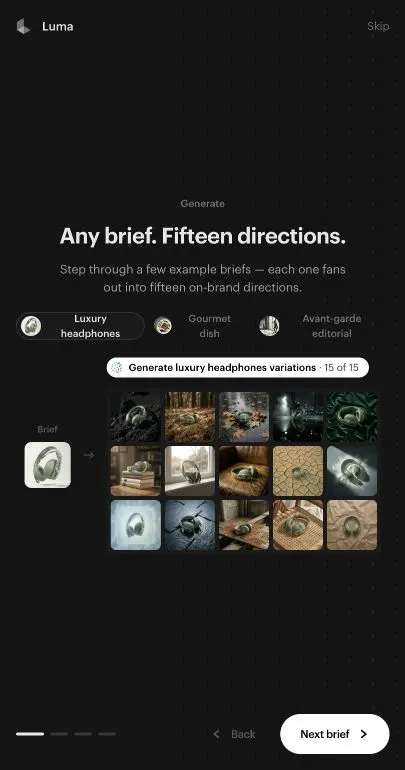
The first thing I like about Luma is that it tries to move beyond the blank prompt box. The app encourages you to start from a brief, explore several directions, and keep the work organized as a board instead of scattering generations across a feed.
That makes Luma especially appealing for brand, agency, social, product, and advertising teams that need many polished variations from the same idea. For narrative filmmakers, it is powerful, but less story-structured than Melies: Luma is strongest when you already know the visual task, while Melies is built around turning a film idea into scenes, characters, storyboards, sound, and production assets.
What I Like About Luma
Luma's strongest idea is the board-based creative workflow. Instead of treating every generation as an isolated output, Luma pushes you toward briefs, directions, variants, and repeatable workflows. That is useful when you are developing a campaign, a visual identity, a trailer mood, or a set of product shots.
The model coverage is also a real advantage. Luma combines its own Ray and Uni models with third-party image, video, and audio models, so it feels more like a creative model hub than a single generator. That matters if you compare tools often and want one workspace for several kinds of outputs.
Ray3.2 is the most interesting part for serious video work. It is designed for transforming existing footage while preserving motion, structure, timing, and performance. The ability to work with keyframes, adherence controls, HDR, EXR export, and 1080p outputs makes it more production-minded than many simple text-to-video tools.
What Could Be Better
Luma can feel broad before it feels simple. If your main goal is to write a story, organize scenes, cast AI actors, and build a full AI film package, the app is less explicitly structured around that filmmaking journey. It is excellent for visual generation and creative variants, but it does not feel as naturally narrative-first as a dedicated AI filmmaking workspace.
The credit system is also something to watch. The paid plans include monthly credit allowances, but real costs depend on which model, resolution, duration, and output options you use. For experimentation this is normal, but for longer projects it can take a little planning.
The screenshot above also hints at the product's main personality: it is polished and direction-led, but it is not a traditional film pre-production board. If you want shot-by-shot story development, dialogue, voice, music, posters, and production planning in one place, you may still want a more filmmaker-specific workflow.
Luma Features: Ray Video, Boards, Skills, and Team Workspaces
Creative Agents and Boards
Luma Agents are meant to help plan, generate, iterate, and refine work with shared context. In everyday terms, that means you can start from a creative brief, explore multiple directions, and keep related assets together instead of managing everything as one-off generations.
Boards are a good fit for product launches, brand explorations, social ad variants, storyboards, trailers, app screenshots, packaging, localized videos, podcast clips, and infographics. I would use Luma when I need a lot of visual directions quickly and want the work to stay coherent.
Luma Skills
Luma Skills are reusable creative workflows inside Luma Agents. The idea is simple: once you find a workflow that works, you can save the method and run it again with new assets. That is useful for teams because it turns repeat prompting into a process that can be shared.
Ray3.2 Video Generation
Ray3.2 is Luma's most production-oriented video workflow. It is strongest when you already have footage and want to transform the look while keeping the motion, composition, timing, or performance. That makes it useful for VFX look development, style transfer, product swaps, environment changes, wardrobe changes, relighting, localization variants, and campaign adaptation.
Ray3.2 supports keyframe guidance, adherence controls for motion and structure, character controls, video-to-video workflows, up to 1080p output, HDR, and EXR export. For post-production teams, HDR and EXR are especially important because they make the output easier to bring into finishing and compositing pipelines.
Team Workspaces
Team Workspaces add the features I would expect for a studio or agency: team members, projects, shared organization, team-wide sharing, usage analytics, shared credits, and SSO on higher-touch plans.
Multi-Model Access
Luma brings together its own models and third-party models, including Ray3.2, Uni-1, Ray3.14, Nano Banana, Nano Banana Pro, GPT Image 2, Seedream, Veo 3.1, Kling 3.0, Kling Omni, Seedance 2.0, and ElevenLabs audio models. This is one of the reasons Luma feels useful for production teams: you can choose the right model for the job without leaving the workspace.
Luma Pricing: Good for Visual Iteration, Harder for Big Volumes
Luma pricing is credit-based and starts with individual creator plans:
- Plus: $30/month, 10,000 credits, Luma and third-party image/video models, guest collaborator edit access, commercial use.
- Pro: $90/month, 40,000 credits, everything in Plus, and 4x usage with Luma Agents.
- Ultra: $300/month, 150,000 credits, everything in Pro, and 15x usage with Luma Agents.
- Team: contact sales, team members, projects, team organization, team-wide sharing, usage analytics, shared credits, and SSO.
- Enterprise: contact sales, enterprise commitments, dedicated education/training, and custom fine-tuning.
Yearly billing can reduce the monthly price, and the app uses credits for generation. The part to pay attention to is model choice: video, resolution, duration, HDR, EXR, and advanced model options can change how quickly credits are consumed.
Luma Alternative: Why Melies Can Be a Better Fit
Luma is best if you want an AI creative agents platform for high-throughput visual work: product visuals, campaign boards, social ads, video variants, storyboards, trailers, brand explorations, and production-ready outputs with Ray3.2 and other models.
Melies is better if your goal is to make an AI film from a story. Melies is built around film structure: story, scenes, AI actors, storyboards, prompts, voices, music, sound effects, posters, and production assets.
If you are searching for a Luma alternative, the key question is workflow. Choose Luma when you need broad creative agents and visual variants. Choose
when you want a filmmaker-first workspace for turning narrative ideas into complete AI film projects.Luma FAQ: Pricing, Features, and Alternatives
What is Luma?
Luma is an AI creative agents workspace for generating, editing, and organizing creative work across video, image, audio, boards, campaigns, storyboards, trailers, product visuals, and production workflows.
Is Luma free?
Luma's individual paid plans start at $30/month. The main paid tiers are Plus, Pro, Ultra, Team, and Enterprise.
How much does Luma cost?
Pricing lists Plus at $30/month, Pro at $90/month, Ultra at $300/month, plus Team and Enterprise plans by contact. Yearly billing says it can save up to 20%.
What is Ray3.2?
Ray3.2 is Luma's video workflow for transforming existing footage with stronger control over motion, structure, keyframes, resolution, HDR, and EXR export.
What are Luma Skills?
Luma Skills are repeatable creative workflows inside Luma Agents. They are useful when a team wants to reuse a successful process instead of rebuilding the same prompt chain from scratch.
What is the best Luma alternative?
Melies is a strong Luma alternative if you want a story-first AI filmmaking workflow with scenes, AI actors, storyboards, prompts, voices, music, sound effects, posters, and production assets.