Morphic is an AI storytelling studio built around a visual workspace rather than a single generator form. Its core product language is Canvas, Copilot, and Compose: generate assets, iterate with an assistant, and assemble video/story pieces in one interface. I would choose it for visual development, storyboards, controlled image edits, and collaborative art direction. I would not choose it as the only system for a film that also needs scripts, actors, voice, music, and final project assembly.
Morphic Review: Visual Planning Works Better Than Full Film Production
Morphic makes a strong first impression because it feels like a visual creative workspace, not just another prompt box. I could enter a real guest Studio and inspect the workflow before creating an account. Canvas, Copilot, Compose, layers, references, tools, and the prompt area are presented as parts of the same workspace, so the mental model is easy to understand: explore ideas visually, ask the assistant for help, then assemble the result into something closer to a finished story.
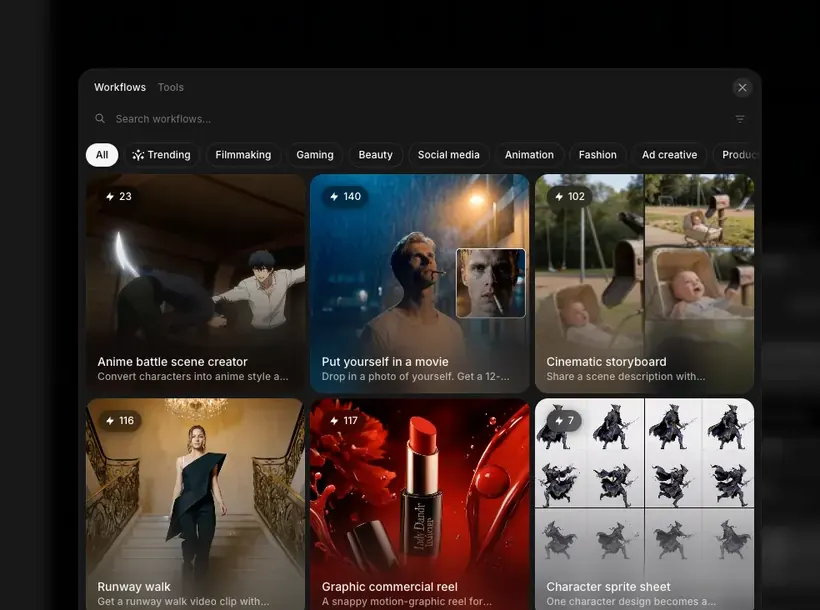
Inside Morphic Studio, the workflow browser offers filmmaking, animation, product, and social starting points instead of leaving every project at a blank prompt.
What I like most is the workflow library. Instead of forcing every creator to invent prompts from scratch, Morphic gives starting points for cinematic storyboards, short films, music videos, product shoots, social content, animation, fashion, and ad creative. That makes the product easier to enter than a blank AI canvas.
The limitation is that Morphic still feels more like visual development and AI art direction than a complete filmmaking system. It helps you generate, animate, edit, and organize visual ideas, but scripts, AI actors, voice, music, sound effects, and full project structure are not as central as they are in
.This review reflects the workspace and workflow surfaces I could use directly. I did not treat a visible template as proof of final output quality; that still depends on the selected model, references, and credits spent on iteration.
Morphic Features: Canvas, Copilot, Compose, and Frame-to-Video
Canvas, Copilot, and Compose
Morphic's Studio page explains the workflow as ideation to final story. Canvas is for generation and editing, Copilot is for prompt-led creative assistance, and Compose is for putting assets together into a finished sequence.
Frames to Video
The Frames to Video feature lets users select 2 to 5 frames of a scene and generate the in-between motion. This is especially useful for creators who want more control than a single image-to-video prompt.
Camera Motion
Camera Motion is useful when a still image needs a more directed move. I like this as a bridge between image generation and video generation because it gives creators a way to think in shots instead of only prompts.
Editing Tools
Morphic highlights object segmentation, remove object, replace object, inpainting, remove background, upscaling, layer-based editing, and precision prompt edits. This makes it relevant for creators who want to revise images and shots rather than regenerate everything from scratch.
Workflows and Templates
The Workflows section is a strong product pattern. It packages complex prompts and tool chains into concrete use cases like ad creative, product shoot, music, photography, restyle, real estate, filmmaking, gaming, beauty, social media, animation, and fashion.
Morphic packages complex creative tasks as reusable workflows, which makes the product easier to enter.
Collaboration
Collaboration matters because Morphic is strongest when teams iterate visually: references, layers, prompts, and workflows all benefit from being kept in the same place.
Morphic Pricing: Credits Need Planning
Morphic has a free entry plan and paid creator/team tiers with monthly credits. Basic is $9, Standard $24, Pro $45, and Pro Max $170, with credit packs sold separately. The exact billing display can change with the monthly/yearly selector, so I would confirm the checkout total before buying.
.The important buying point is not just the monthly price; it is how fast your credits disappear. Morphic also sells credit packs, and credits consumption varies by operation, so I would check the plan table and credit breakdown before using it for a real production sprint.
For a filmmaker, the plan decision depends on whether Morphic is a pre-production canvas or the place where most visual assets are generated. A light storyboard workflow can fit a smaller allowance; repeated frame-to-video, inpainting, and motion experiments need more headroom.
What Could Be Better in Morphic
Morphic would be more compelling for filmmakers if the story layer felt as strong as the visual layer. The workflows are useful, but a film project still needs continuity, scene planning, character control, voice, sound, and production assets to live together. That is where Morphic can feel lighter than a dedicated AI filmmaking workspace.
Morphic Alternative: Why Melies Can Be a Better Fit
Morphic is strongest for visual ideation, AI canvas workflows, image/video editing, frames-to-video, camera motion, and collaboration. Melies is stronger for creators who want the broader filmmaking stack: AI actors, storyboards, posters, scripts, video clips, voice, music, and model selection in one project.
For users searching for a Morphic alternative, Melies is the better fit when the goal is producing film assets and maintaining character or story continuity. Morphic is a strong option for visual exploration and collaborative AI art direction.
Morphic FAQ: Pricing, Features, and Alternatives
Is Morphic free to use?
Yes. Morphic has a free entry plan for trying the product. Paid plans unlock more credits and broader production use.
How much does Morphic cost?
Morphic has a free plan, paid creator/team plans, and credit packs. Because generation costs vary by operation, the safest way to judge value is to compare the monthly credit allowance against the kind of video, image, and audio work you expect to generate.
Does Morphic support collaboration?
Yes. Morphic positions collaboration as a core part of the product, and its product site highlights live collab, team workflows, and shared creative work.
What is the best Morphic alternative?
Melies is a strong Morphic alternative if you want an AI filmmaking workspace with actors, storyboards, posters, voice, music, scripts, and video generation together.