CGDream is best described as an AI image and 3D visual creation platform. It is useful for concept art, product visualization, style exploration, image editing, 3D model generation, and image upscaling, but it is not a full AI filmmaking workspace.
CGDream Review: Strong Visual Lab for Images and 3D, Not Film Planning
CGDream is worth testing if you want a visual playground that mixes gallery browsing, text-to-image, image references, 3D references, filters, and 3D generation ideas. The app feels more like a creative image-and-asset lab than a filmmaker workspace, but the 3D-aware controls make it interesting for concept art, props, environments, and style exploration.
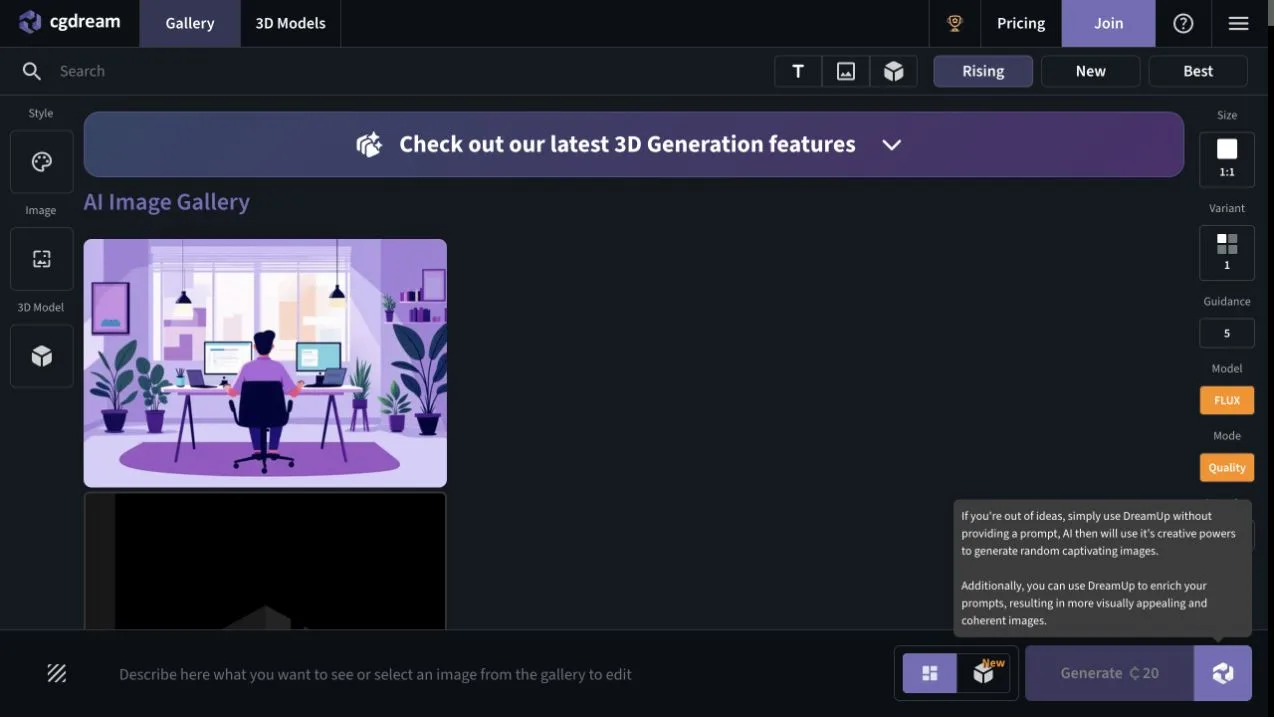
The gallery workspace is more app-like than a normal marketing page. It puts image browsing and generation controls in the same view: text, image, and 3D filters, rising/new/best gallery sorting, a prompt composer, size and variant settings, guidance, model selection, quality mode, filters, image/3D generation modes, and a visible credit cost before generation.
For filmmakers, the useful part is that CGDream combines visual generation with 3D-aware references. It feels better suited to concept art, props, locations, and style exploration than to managing a full story-to-video production.
CGDream Features: Image Generation, 3D Inputs, Filters, and Upscaling
CGDream currently exposes:
- Text-to-image generation.
- Image-to-image visual editing.
- 3D-to-image rendering.
- Text-to-3D and image-to-3D generation.
- A 3D model gallery.
- AI filters and LoRA-style visual controls.
- AI image upscaling.
- AI image inpainting.
- Public gallery and community feeds.
- AI art challenges and Discord/community positioning.
The 3D generator page says CGDream is built on Rodin and can generate models from text or images. It describes controls for mesh type, polygon count, materials, quality, export format, and roughly 90-second image-to-3D processing depending on input.
For filmmakers, CGDream is most useful as a visual exploration tool. I would use it for concept images, props, environments, poster directions, and early 3D asset ideas. I would not expect it to manage the production layer: screenplays, scenes, shot lists, actors, voice, music, sound design, video clips, or continuity.
CGDream Pricing: Generous Free Credits, Paid Plans for Commercial Work
CGDream pricing is credit-based, so the practical question is how many images, edits, or 3D generations you expect to run each month:
- Free: $0/month, 3,000 monthly credits, 100 credits per day, text-to-3D, image-to-3D, 2 image variations, 2 concurrent generations, regular generation priority, limited history/search, no private mode, no commercial use, 3 challenge submissions, and inpainting.
- Basic: $10/month, 10,000 monthly credits, unlimited daily credits, 4 image variations, 3 concurrent generations, increased priority, unlimited history/search, private mode, commercial use, relaxed generations, deletion, 10 challenge submissions, and inpainting.
- Pro: $30/month, 40,000 monthly credits, 4 concurrent generations, slow mode, relaxed generations, 20 challenge submissions, and paid-plan features.
- Premium: $60/month, 90,000 monthly credits, 5 concurrent generations, slow mode, relaxed generations, 30 challenge submissions, and paid-plan features.
The FAQ says unused subscription credits expire at the end of the current billing cycle if not used or renewed. Free users can wait for daily credits to replenish; premium users can continue with lower-priority generation or top up.
CGDream Alternative: Why Melies Can Be a Better Fit
CGDream is stronger when the task is visual generation: concept art, 3D model ideas, styleframes, product visuals, image repair, image upscaling, and 3D-to-image experiments. It is a good place to explore looks, not to manage the whole film.
Melies is stronger when the task is AI filmmaking. It gives creators a project-centered workflow for story, scenes, characters, AI actors, prompts, storyboards, voices, music, sound effects, posters, and production assets.
For people searching for a CGDream alternative, the distinction is simple: CGDream helps make visuals; Melies helps make films.
CGDream FAQ: Pricing, Features, and Alternatives
What is CGDream?
CGDream is an AI visual creation app for generating images from text, images, and 3D models, plus text-to-3D, image-to-3D, filters, upscaling, inpainting, and gallery/community workflows.
What is the best CGDream alternative?
Melies is a better CGDream alternative for filmmakers who need a complete AI film workspace with story, scenes, characters, prompts, storyboards, voices, music, sound effects, posters, and video planning.