Scenario has evolved into a creative AI infrastructure platform, not just an image-generation tool. I would use it when the job is repeatable asset production: custom model training, image/video/3D/audio/text generation, workflow automation, app-like templates, API access, MCP tooling, and a large model library in one workspace.
For filmmakers, Scenario is most relevant when the job is visual asset production at scale: concept art, consistent character visuals, product or fashion assets, storyboards, animated videos, talking avatars, 3D models, audio, textures, skyboxes, and repeatable node workflows.
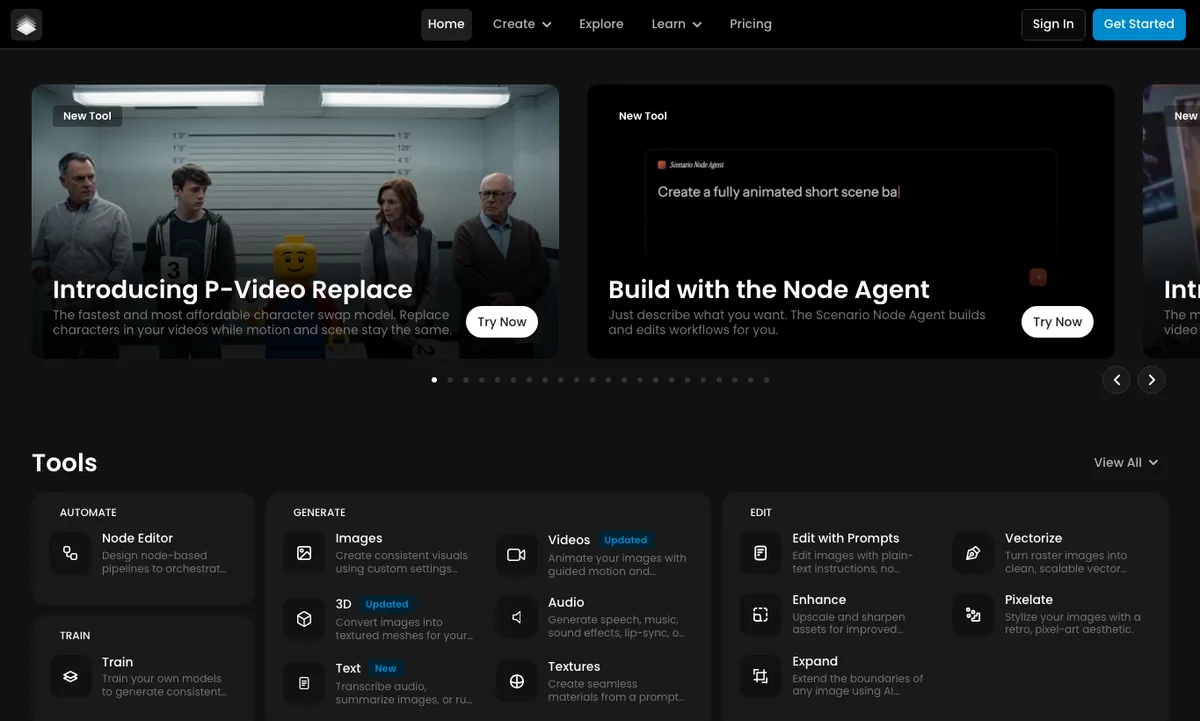
Scenario Review: Best for Asset Pipelines and Custom Models
The part I like most about Scenario is that it feels built for production teams, not only casual prompting. The homepage workspace shows a tool grid with Node Editor, training, image, video, 3D, audio, text, textures, live creation, prompt-based editing, enhancement, expansion, background removal, retouching, vectorization, and pixel art.
That makes Scenario useful when you need repeatable outputs with a consistent style. It feels especially strong for game teams, studios, agencies, and creators who want model access, automation, and custom visual systems rather than a single prompt box.
Scenario Features for Custom Models and Creative Workflows
Custom Models and Creative DNA
Scenario's product overview frames the product around training on an art bible, style references, or a visual library. It says users can train on 5-100 reference images and create custom LoRA models for style, brand consistency, and repeatable output.
Models, Workflows, and Apps
Scenario brings together 500+ models and 50+ providers. The useful part is not only the model count; it is the way Scenario combines image, video, audio, text, 3D, workflow, and editing use cases into reusable apps and node flows. For film-adjacent work, examples like storyboards, character sheets, cinematic videos, talking avatars, and 3D pipelines are the most relevant.
API and Enterprise Readiness
Scenario also makes sense for teams that care about API access, private workspaces, SSO, governance, storage, and collaboration. That is overkill for a solo creator making one short film, but valuable for a studio or company producing lots of branded assets.
Scenario Pricing: Creator and Team Credits for Visual Consistency
Scenario pricing is credit-based and split by creator/team needs.
- Starter: $15/month or $10/month billed annually, 1,500 monthly credits, single-user workspace, 65+ core AI models, private generations, community support, 50 GB storage.
- Pro: $45/month or $30/month billed annually, 5,000 monthly credits, priority queue, unlimited relaxed generations, custom model training, editing models, 30+ advanced models, ticket support, 500 GB storage.
- Max: $75/month or $50/month billed annually, 10,000 monthly credits, workspace for up to 25 users, team collaboration, custom editing model training, monitoring dashboards, high-priority queue, 1 TB storage plus extra per seat.
- Enterprise: custom pricing, annual billing with minimum 10 users, SSO, SOC 2, governance, dedicated account team, Slack support, advanced dashboards, audit trail, and add-ons.
Credits do not roll over, so Scenario is easiest to budget when you already know roughly how much generation, training, or workflow automation your team needs each month.
Scenario: What I Like and What Could Be Better
I like Scenario most when I think of it as a production system. Custom models, node workflows, model comparison, batch generation, apps, and API access are all useful if you need a repeatable visual pipeline.
What could be better for filmmakers is the story layer. Scenario is excellent at producing and automating assets, but it does not feel like the place where I would manage a script, scene list, cast, voice direction, sound design, posters, and final film workflow from one story-first project.
Scenario Alternative: Why Melies Can Be a Better Fit
Scenario is strongest for teams that need custom model infrastructure, multi-model generation, API/MCP access, workflow automation, and asset production at scale.
is stronger for creators who want to make an AI film from the story outward. Melies connects story, scenes, AI actors, storyboards, posters, prompts, voices, music, sound effects, and generated video in one film project. For someone searching for a Scenario alternative, the question is whether they want creative infrastructure or a story-first AI filmmaking workspace.Scenario FAQ: Pricing, Features, and Alternatives
Does Scenario support video?
Yes. Scenario supports video generation and video-oriented workflows alongside image, 3D, audio, text, editing, workflows, apps, API access, and custom model training.
Is Scenario only for game assets?
No. Scenario still has strong game-asset roots, but the current product spans image, video, audio, text, 3D, workflows, apps, agents, API, and MCP tooling.