Hailuo AI is a Chinese AI creation workspace from MiniMax. The product opens straight into a creation interface for video, image, audio, tools, Hub, and Hailuo Agent workflows, which makes it feel more like an app than a sales site.
Hailuo AI Review: Fast Chinese Video Workspace With Language Friction
The first thing I like about Hailuo is how quickly it gets to the generator. The video composer brings together first-frame and last-frame inputs, a prompt field, Hailuo 2.3 model selection, first/last-frame mode, 768p output, 6-second duration, and a credit cost in one compact workspace.
The interface is Chinese-first. For a non-Chinese-speaking filmmaker, that is the biggest practical friction. For creators comfortable with Chinese workflows, it is a surprisingly direct app surface.
Image-to-Video and Templates
The image-to-video workflow is more focused, with video/image/audio mode toggles and template cards. Examples include fashion walk, armor awakening, and ad-style prompts.
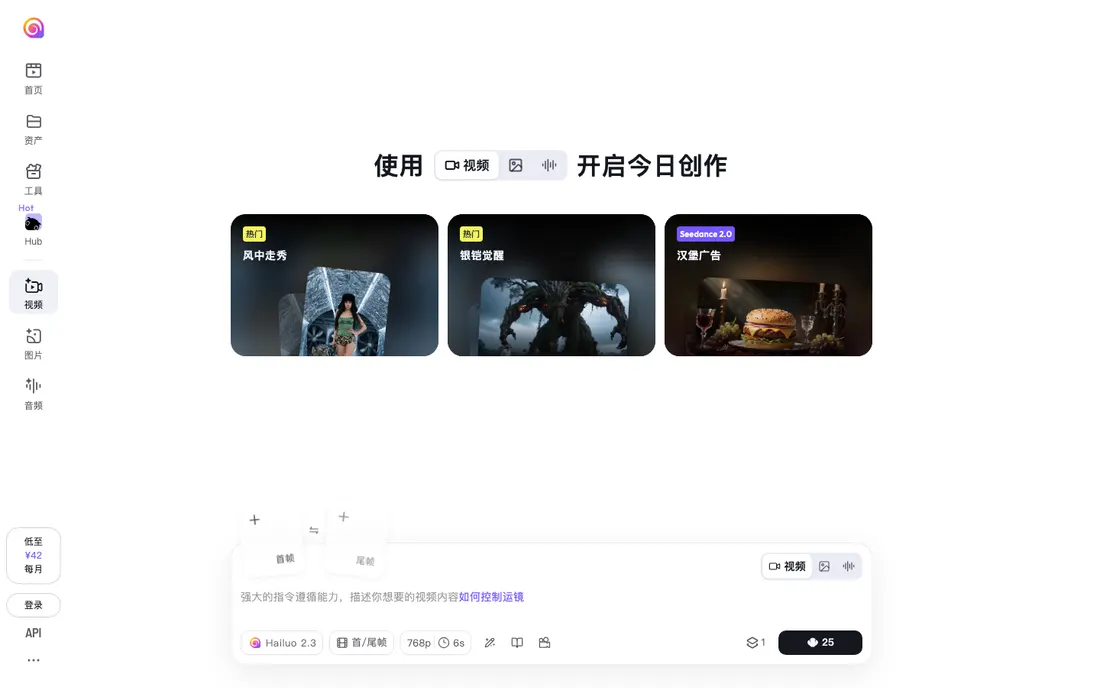
This is the best part of the product for quick filmmaking experiments: first frame, last frame, prompt, model, resolution, duration, and template ideas live in one compact interface.
Hailuo AI Pricing: RMB Subscription Plans Built Around Shells
Hailuo pricing is in RMB and uses monthly "shells" for generation. The Free plan gives trial credits and access to Hailuo-series models. Paid annual tiers start around Basic at ¥55/month with 1,000 shells, then scale to Standard at ¥196/month, Master at ¥463/month, and Premium at ¥1399/month for higher monthly shell allowances, more estimated videos, better queues, and broader model benefits.
The pricing is attractive if Hailuo is one of your main generation tools, but it takes a little work to estimate. Different models, quality levels, queues, lip sync, music generation, audio generation, image generation, and video enhancement can affect how quickly credits disappear.
What I Like and What Could Be Better
Hailuo puts the creation surface right in front of the user. You can inspect video generation, image generation, audio, templates, agents, and pricing without hunting through a sales site.
The first-frame and last-frame workflow is especially relevant for filmmakers because it gives a simple way to define shot endpoints. The template categories also make it fast to understand common use cases: fashion, ads, pets, ASMR, horror, cinematic scenes, and style transfer.
What could be better is the film workflow around the generator. Hailuo is good for making clips, but it is not organized around scripts, scenes, characters, storyboards, sound design, or project continuity. The Chinese-first interface and RMB pricing also add friction for international creators who want a straightforward production workspace.
Hailuo AI Alternative: Why Melies Can Be a Better Fit
Hailuo AI is stronger for fast Chinese-language visual generation: Hailuo 2.3, first/last-frame video, templates, agents, image generation, audio, and subscription credits.
Melies is stronger when you need the whole film workflow in one place. Melies connects story, scenes, actors, prompts, storyboards, voices, music, sound effects, and video generation. If you are looking for a Hailuo AI alternative for AI filmmaking, Melies is broader and easier to use as a production workspace. If you specifically need Hailuo/Minimax video experiments, Hailuo is the specialist.
Hailuo AI FAQ: Pricing, Features, and Alternatives
Does Hailuo AI have a free plan?
Yes. Hailuo has a free plan at ¥0/month with one-time free trial credits and access to Hailuo-series models.
How much does Hailuo AI cost?
Annual subscriptions list Basic at ¥55/month, Standard at ¥196/month, Master at ¥463/month, and Premium at ¥1399/month. Hailuo also advertises lower promotional entry pricing in some navigation surfaces, so the exact entry price can vary.
What is the best Hailuo AI alternative?
Melies is a strong Hailuo AI alternative if you want a complete AI filmmaking workflow. Hailuo is useful for short video generation and Chinese-language creative templates; Melies is better for story-to-video production with scenes, prompts, audio, storyboards, and video in one workspace.